
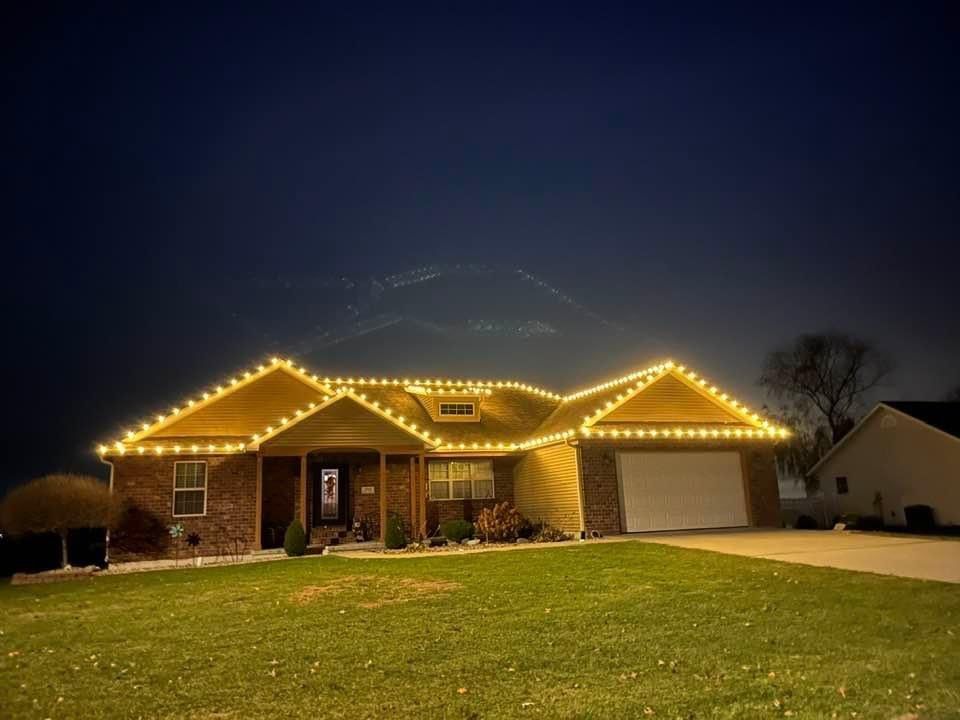
Walk a well-lit street in Champaign’s Cherry Hills or Bloomington’s Hawthorne and the houses that stop you have one thing in common: big, bright, evenly spaced bulbs along every roofline. Those are C9s. Here’s what they are and why we use the LED version on every install.
What a C9 bulb is
C9 is a bulb size, not a brand. The bulb is a cone about 1.25 inches across and 2.25 inches tall, screwed into an E17 socket, spaced every 12 inches (or 9 on a dense line). It’s the bulb that outlined houses in the 1950s and 60s, and it’s still the standard for professional rooflines because it’s big enough to read from the street and from a car.
C7 is the smaller sibling, used on shorter homes and smaller features. Mini lights are the small bulbs on green wire used for tree wrapping and greenery.
Incandescent C9s: the original
Incandescent C9s have a warm, familiar glow and a certain nostalgia. They also draw about 7 watts each, which means a 100-bulb roofline pulls 700 watts, and a full two-story outline can trip breakers. They run hot, the filaments break when the line is handled, and the glass bulbs shatter when they hit a gutter. They’re also hard to find in commercial grade anymore.
LED C9s: what replaced them
Modern LED C9s use a faceted plastic lens over an LED, in the same size and socket as the original. The differences:
- Power: About 0.5 to 1 watt per bulb versus 7. A tenth of the draw. A whole house runs on one circuit.
- Heat: Cool to the touch. No melted clips, no fire risk at the roofline.
- Durability: No filament, no glass. Bulbs survive handling, storage and the occasional hit from sliding snow.
- Color: Warm white LEDs at 2700K look like incandescent. Cool white, red, green, blue, orange, purple and pink are saturated and consistent from bulb to bulb.
- Life: Rated for tens of thousands of hours. With proper storage, many seasons.
Commercial LED C9 lines vs. box-store strands
This is the comparison that matters. Box stores sell LED C9 strands too, but they’re built to a price:
| Commercial C9 line | Box-store strand | |
|---|---|---|
| Wire | Heavy-gauge SPT-2, custom cut to the run | Thin fixed-length cord |
| Sockets | Weather-sealed, replaceable bulbs | Sealed strand; one failure can take out a section |
| Spacing | Exact to your roofline, no gaps | Fixed length, bunched or short at the ends |
| Bulbs | Faceted, consistent color | Variable color and brightness |
| Repair | Swap one bulb | Replace the strand |
| Lifespan | Many seasons with storage | Two or three seasons |
We build every roofline from commercial line cut to the exact length of each run on your home, which is why bulbs land perfectly at corners and peaks. See roofline lighting for how that’s done.
Warm white, cool white, or color?
Warm white (2700K) is the classic and the most requested across Central Illinois. It flatters brick, stone and every siding color and is allowed by essentially every HOA. Cool white (5000K+) reads crisp and modern on white, gray and dark homes. Colors work best as alternating pairs, red and white, blue and white, red and green, or as the traditional multicolor on ranches and farmhouses. We can show you each on your home during the design visit.
Bottom line
If you want the big-bulb roofline look, you want C9s, and today that means commercial LED C9s on custom-cut lines. They’re brighter, safer, cheaper to run and last longer than anything from a store shelf, and they’re what every display we install is built on.