
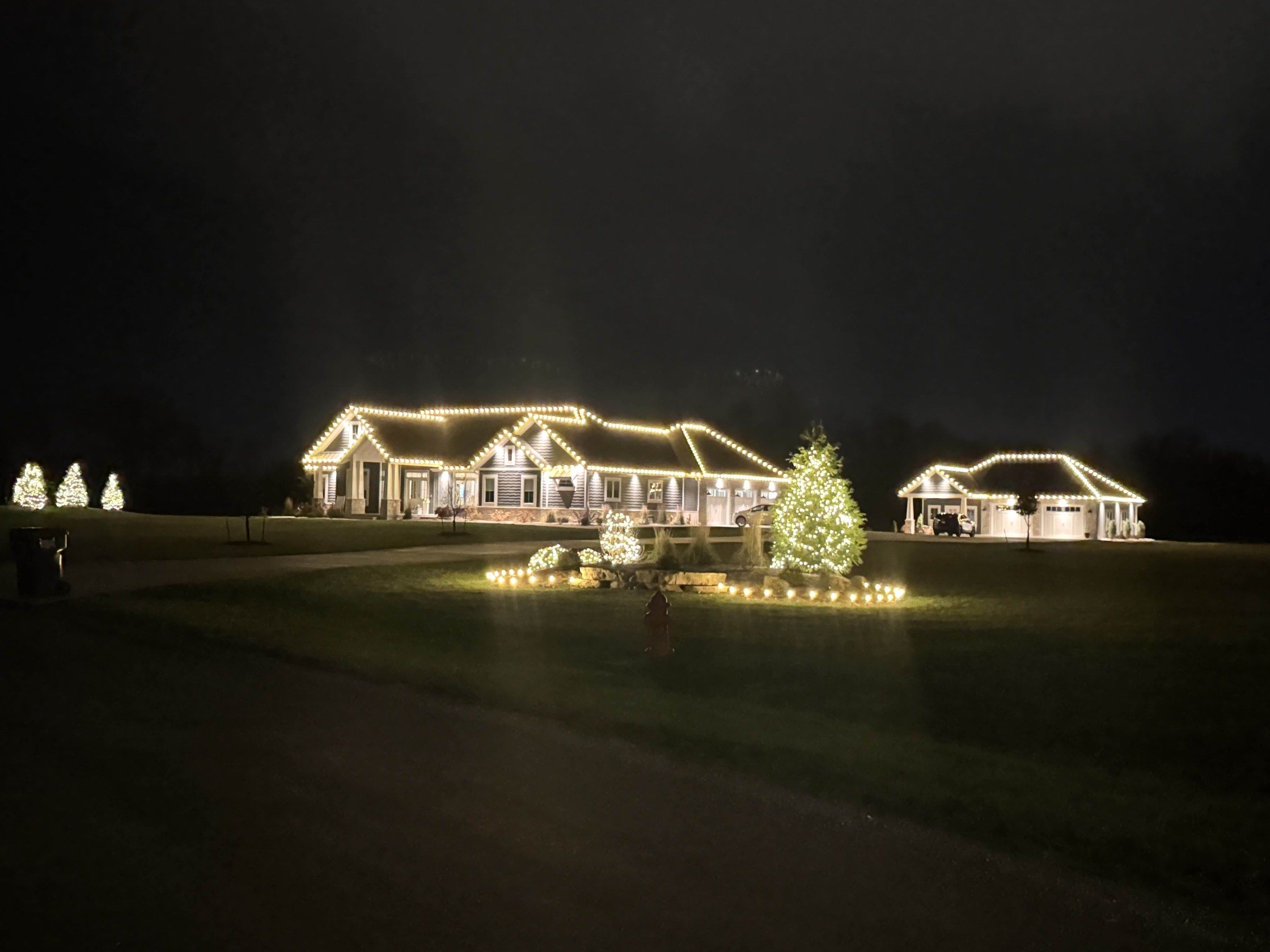
Every December, emergency rooms see thousands of holiday-decorating injuries, most of them falls. Most are avoidable. Whether you hang your own lights or hire us, here’s what matters for safety on the roof, on the ladder and at the outlet.
Ladder safety
- Use the right ladder. An extension ladder for anything above a single story. Step ladders are for the porch, not the gutter line.
- Set it correctly. Base one foot out for every four feet of height, on firm, level ground, never on frozen mulch or a slope.
- Three points of contact. Two hands and a foot, or two feet and a hand, at all times. If you need both hands, you need a different setup.
- Don’t lean. Your belt buckle stays between the rails. Move the ladder instead of reaching.
- Use a standoff. A standoff bracket holds the ladder off the gutter and gives you room to work. Our crews use them on every job.
- Have a spotter. Someone holding the base and watching is the single most effective safety measure.
- Watch the weather. Wet, icy or windy conditions are a reason to stop. December afternoons in Central Illinois get dark by 4:30; don’t finish in the dark.
Roof safety
Shingles are slippery when wet, frosty or dusted with snow, and gutter edges are not footholds. If a design requires walking the roof, it requires roof-rated footwear, a dry surface and ideally fall protection. Our crews avoid walking roofs where possible by working from ladders with standoffs, and never work icy roofs. For most homeowners, the answer is simpler: stay off the roof.
Attachment: clips, never staples
Staples and nails pierce wire insulation, which creates shock and fire hazards and shorts out strands. They also damage fascia and shingles. Use clips designed for the surface: shingle clips that slide under the shingle edge, gutter clips that hook the lip, ridge clips for peaks. They hold in wind and come off clean in January. This is how we attach every line.
Electrical safety
- GFCI outlets only. Outdoor lights should plug into GFCI-protected exterior outlets with weatherproof in-use covers. A GFCI trips when water causes a fault, which is exactly what happens in freezing rain.
- Outdoor-rated cords. Extension cords must be rated for outdoor use, heavy enough gauge for the run, and kept out of standing water and off walkways.
- Don’t overload circuits. Incandescent C9s draw about 7 watts each; a hundred of them is 700 watts. LED C9s draw a tenth of that, which is one reason we use them. Check the strand’s maximum end-to-end connections.
- Keep connections dry. Plug junctions should be off the ground or in weatherproof connection boxes.
- Timers. A timer or photocell means lights aren’t running unattended all night and saves power.
Ice, snow and wind
Central Illinois winters bring freezing rain, a foot of snow sliding off the roof, and 40 mph prairie wind. Lines need to be clipped at close intervals and anchored at corners so gusts don’t lift them, routed clear of spots where ice sheds from trees or valleys, and inspected after storms. If a line is down, don’t climb up in the weather to fix it; wait for safe conditions.
When to call a professional
If your home has second-story gables, if the roofline is complex, if you’d be working alone, or if you simply don’t want to be on a ladder in December, hire it out. A professional install includes commercial-grade lights, proper clips, safe power routing and, with us, free maintenance so you never go up to fix a bulb. Our professional vs. DIY comparison covers the trade-offs honestly.
And if you’d rather never think about any of this again, permanent lighting puts the lights up once, on a sealed track, with nothing to climb for.