
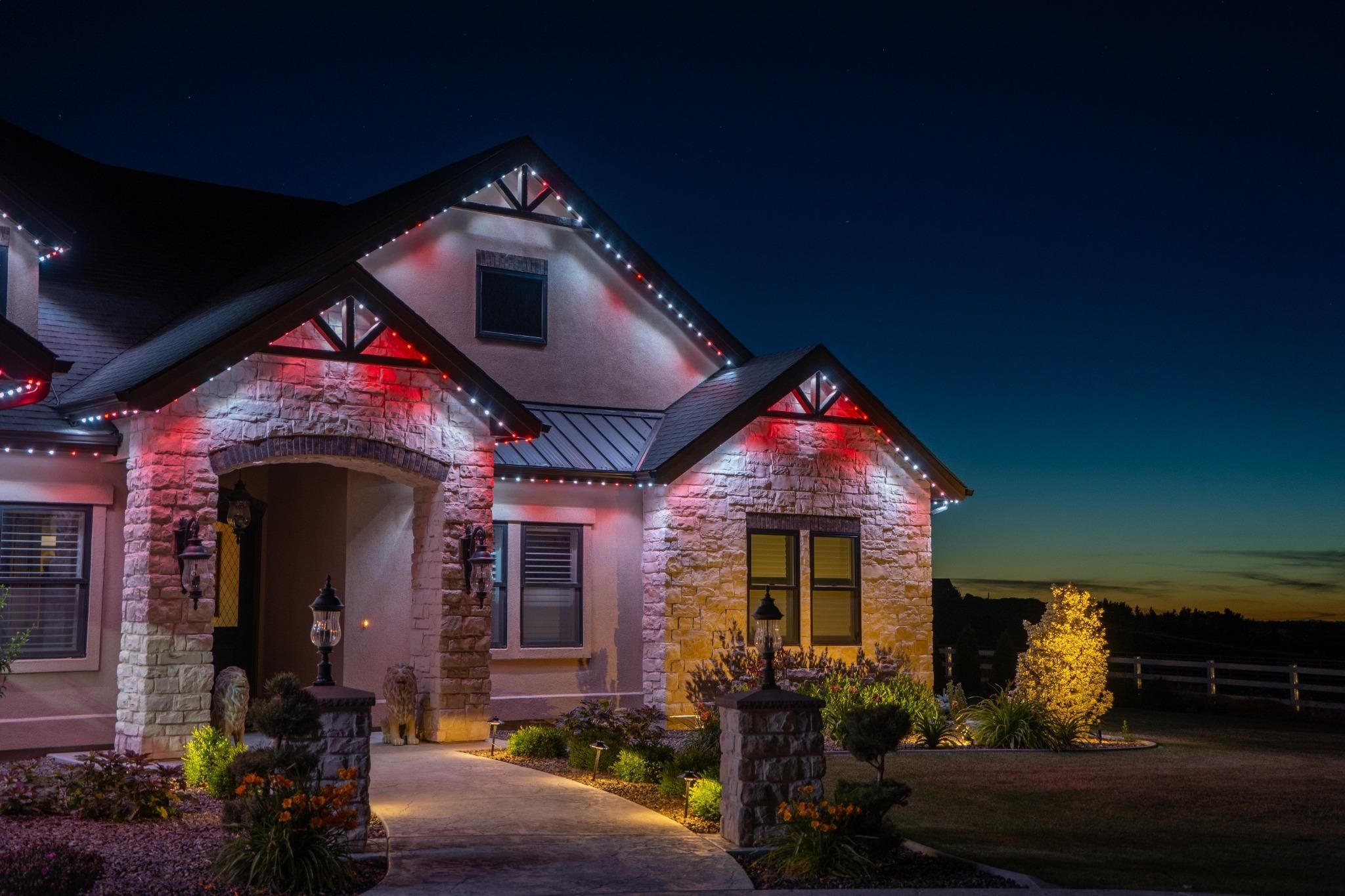
We install both permanent and seasonal lighting, so we don’t have a horse in this race. Some homes should go permanent. Some should stay seasonal. A lot should do both. Here’s how to decide.
New to the idea? Start with our overview of permanent Christmas lights: what they are, how they look and where we install them.
What each one actually is
Seasonal Christmas lights are the classic display: commercial-grade LED C9 bulbs on custom-cut lines clipped to your roofline, plus wrapped trees, netted shrubs, wreaths, garland and pathway lights. A crew installs them in the fall, maintains them, removes them in January and stores them. Full details here.
Permanent lighting is a slim aluminum track, color-matched to your trim, mounted under the eave with RGB+W LED modules every 9 inches. A controller near an outlet connects to an app. You install it once and change colors, patterns and schedules from your phone, year-round. Full details here.
How they look
At Christmas, in warm white, from the street: nearly identical. The 9-inch spacing on a permanent system matches a professional C9 line, and the dedicated warm-white diode is a true 2700K.
Up close, seasonal C9 bulbs are bigger and have a faceted sparkle that permanent modules don’t. If you love the look of big bulbs, seasonal wins on that detail.
Where seasonal clearly wins is everything that isn’t the roofline: wrapped trees, lit evergreens, garland on the porch, wreaths in the windows. A permanent system is a roofline system. You can add seasonal trees and greenery to it, and many customers do.
Where permanent clearly wins is daytime. In January through October, a permanent track is invisible. A seasonal install is gone, which is also fine. But permanent gives you a lit house on 300 nights that seasonal doesn’t touch.
Flexibility
Permanent lighting does things a seasonal install cannot: Illini orange and blue on Saturdays, orange and purple on Halloween, red, white and blue on the Fourth, pink in October, pastels at Easter, and a warm white accent glow every ordinary night. All from the couch. If you’d use those, permanent is a different product, not just a different way to do Christmas.
Seasonal lighting is flexible in a different way: every year you can change the design, the colors, the trees, the greenery, without touching the house. It’s also the only option for some situations: rental homes, homes you plan to sell soon, and homes with roof edges that don’t suit a track.
Cost over time
Year one, seasonal costs less. It’s a service fee rather than a system purchase. Permanent is a larger one-time investment, priced per foot of roofline. Our permanent lighting cost guide and seasonal cost guide explain what drives each.
Over time, the math shifts. A seasonal display is an annual expense for as long as you want lights. A permanent system has no annual install, takedown or storage cost, runs on a few watts and is rated for 25+ years with our 5-year warranty. For a home that lights up every year, permanent usually breaks even within several seasons and runs for free after that. For a home that lights up occasionally, seasonal is the better value.
Maintenance and weather
Both are built for Illinois winters. Seasonal lines use sealed sockets and replaceable bulbs, and maintenance is free all season. Permanent systems have no exposed wire, no clips to blow off and nothing on the roof to ice up; the track is screwed to the fascia and sealed. A permanent system simply has fewer things that can go wrong in a storm.
Which homes suit each
Go permanent if you:
- Light up every year and are tired of the annual cycle
- Want game-day, Halloween, Fourth of July and everyday accent lighting
- Own a large home where the seasonal roofline is a big annual job
- Plan to stay in the home for years
Stay seasonal if you:
- Love big C9 bulbs, wrapped trees and greenery as the centerpiece
- Only decorate for Christmas
- Rent, or plan to sell soon
- Want to change the whole design every year
Do both if you: want the year-round convenience of a permanent roofline and the full December scene with trees and greenery. This is increasingly the most popular choice in Champaign’s and Bloomington’s larger subdivisions.
Still not sure? Request a quote and tell us you want to talk through both. We’ll measure, show you the track color on your trim and give you honest numbers for each.